
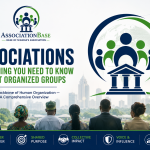
The Backbone of Human Organization — A Comprehensive Overview
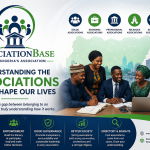
Every Nigerian has belonged to something. Maybe it was your departmental association at university, your town’s development union, a cooperative thrift group in your street, a church committee, or a professional body you joined after your NYSC. Even if you have never consciously identified with the word “association,” the reality is that organized groups have shaped nearly every dimension of your life — from the school you attended to the neighbourhood you live in, from the profession you practice to the faith you hold.
Associations are not bureaucratic abstractions. They are living, breathing structures through which human beings organize themselves to achieve what they cannot achieve alone. They are the structures behind the Nigerian Bar Association fighting for rule of law, the Academic Staff Union of Universities (ASUU) negotiating for better education, the Arewa Consultative Forum influencing northern policy, the Ohaneze Ndigbo advocating for Igbo interests, and the thousands of community development associations quietly building roads and boreholes across local government areas.
At AssociationBase, our purpose is not to celebrate or condemn associations. It is to understand them — deeply, clearly, and honestly. This article is the beginning of that journey. Whether you are a student writing a paper, a researcher building a framework, a young professional deciding whether to join a body, or simply a curious Nigerian who wants to understand how organized groups actually work, this guide is written for you.
We will take you from the very definition of an association to its history, its types, its governance, its problems, and what makes it thrive or collapse. By the end, you will not just know what an association is — you will understand how it thinks, how it behaves, and why it matters.
What Is an Association?
Before we can understand associations, we must define them carefully. The word is used loosely in everyday Nigerian conversation — sometimes to mean a club, sometimes a union, sometimes a community gathering. But a proper understanding requires precision.
At its most basic level, an association is a group of people who come together around a shared purpose, operate under agreed rules, and sustain their relationship over time. This is the plain definition. Simple, but it carries weight.
From a sociological standpoint, an association is a form of organized social action. The German sociologist Max Weber distinguished between a “communal relationship” — where people act based on feeling or tradition — and an “associative relationship” — where people act based on rational agreement toward a shared goal. An association, in this sense, is a deliberate, rational, and structured form of human grouping.
Legally, in Nigeria and across most of the world, an association becomes a recognized entity when it is registered with a government authority — such as the Corporate Affairs Commission (CAC) in Nigeria. Legal registration grants the association rights: to own property, enter contracts, sue and be sued, and operate officially. However, not all associations are registered. Many powerful and influential associations in Nigeria — from community age-grade groups to market women cooperatives — operate informally yet exercise enormous social authority.
Structurally, we at AssociationBase define an association as any organized group that possesses five core attributes: membership, a shared purpose, governing rules or norms, some form of leadership or coordination, and continuity over time. When these five elements are present, you have an association — regardless of what it calls itself.
The Core Elements of an Association
Understanding what makes a group an association — rather than just a crowd or a temporary gathering — requires looking at its essential building blocks. These elements are not optional extras. They are what give an association its identity, its durability, and its function.
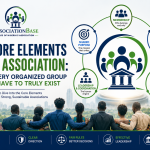
The Core Elements of an Association are:
- Membership
- Shares Purpose
- Rules or Norms
- Leadership or Coordination
- Continuity over time
Membership
Membership defines who belongs to the association and on what basis. In the Nigerian Civil Service Association, you must be a civil servant. In the Nigerian Medical Association, you must be a licensed physician. In your community’s age-grade association, you must belong to a particular birth cohort. Membership sets the boundary of the group — who is inside and who is not.
Shared Purpose
Shared purpose is the reason the association exists. It is the mission that gives the group meaning. Without shared purpose, membership is hollow. The Nigerian Union of Teachers exists because teachers share the common interest of professional dignity, welfare, and education advocacy. Without that unifying purpose, the organisation would have no reason to exist.
Rules or Norms
Rules or norms govern how the association operates. They may be written — as in a constitution, bylaws, or a memorandum of association — or unwritten, as in the informal expectations of a street traders’ cooperative. Rules answer the questions: How are leaders chosen? How are decisions made? What happens when someone misbehaves? In Nigeria, many association crises begin precisely because these rules are weak, absent, or selectively applied.
Leadership or Coordination
Leadership or coordination refers to the human beings who guide the association’s direction. This may be a president, secretary-general, board of directors, elders’ council, or even a rotating chairperson. Every functional association requires someone — or some body — to coordinate action, manage resources, and represent the group externally.
Continuity over time
Continuity over time is what separates an association from a one-time event. An association is designed to persist. It survives the departure of individual members. When your departmental association’s executives graduate, new ones take over. That institutional continuity is what makes an association a structure rather than a moment.
These five elements — membership, shared purpose, rules, leadership, and continuity — are the skeleton of every association, from the smallest community women’s group in Benue State to the African Union.
A Brief History of Associations
Human beings have always organised themselves into groups. Long before the word “association” existed, the thing it describes was already shaping societies across the world.
The earliest associations were tribal formations — groups bound by kinship, shared land, and collective survival. In pre-colonial Nigeria, these formations were sophisticated and functional. The Yoruba Ogboni society, the Igbo Okonko and Ekpe secret societies, and the Hausa emirate councils were all forms of organized associational life. They governed, judged, preserved culture, and regulated economic activity.
As human civilizations developed, religious orders emerged as powerful associational forms. Monasteries in medieval Europe, Islamic brotherhoods (tariqas) across West Africa, and Christian missions in colonial Nigeria were all associations with clear membership criteria, hierarchies, rules, and missions. The Tijaniyya and Qadiriyya brotherhoods, still influential in northern Nigeria today, trace their roots to centuries-old Islamic associational traditions.
The guild system of medieval Europe formalized economic associations among craftsmen and traders — an early equivalent of today’s trade associations and professional bodies. In Nigeria, market guilds and craft cooperatives performed similar functions long before colonization. The Igba trading networks of Aro traders and the Hausa fatauci long-distance trading associations were sophisticated economic associations operating across regions.
The industrial revolution gave rise to modern trade unions — associations formed by workers to collectively negotiate with employers. In Nigeria, the Trade Union Congress (TUC) and the Nigeria Labour Congress (NLC) are direct descendants of this tradition, with roots going back to the Nigerian Civil Service Union of 1912.
Political associations emerged as vehicles for ideological mobilization and governance. In colonial Nigeria, early political associations — like the National Council of Nigeria and the Cameroons (NCNC) — were instrumental in the independence movement. Today, political parties, pressure groups, and advocacy platforms carry that legacy forward.
In the 21st century, digital communities have introduced a new associational form. Nigerian Twitter (now X) communities, WhatsApp alumni groups, Facebook community pages, and LinkedIn professional circles are modern associations — informal but real, boundary-less but purposeful.
The story of associations is, in many ways, the story of human civilization itself.
Why Human Beings Form Associations
If you have ever wondered why people bother organizing into groups at all — with all the meetings, politics, and paperwork that comes with it — the answer lies in what individuals cannot achieve alone.
Survival and protection was the original reason. Early human communities banded together because isolation meant death. This logic still holds. In rural Plateau State, farmers form cooperative associations partly because collective bargaining with buyers gives them a pricing power no individual farmer could achieve alone. In urban Lagos, residents’ associations exist partly because collective action is the only realistic way to secure basic amenities like security and drainage.
Identity and belonging is one of the most powerful human motivations. We define ourselves partly through our affiliations. Being a member of your state students’ association in Abuja, your professional body, or your church committee tells you — and the world — something about who you are. Associations are identity markers as much as they are functional organizations.
Economic advantage drives the formation of cooperatives, trade unions, chambers of commerce, and business networks. When Aba textile traders form an association, they gain access to bulk buying, shared market intelligence, collective dispute resolution, and regulatory representation that no single trader could access independently.
Power accumulation is a less romanticized but equally real motivation. Political parties, caucuses, blocs, and pressure groups exist because power is easier to acquire and sustain collectively. The history of Nigerian politics is in many ways a history of associational power — which ethnic coalition, which professional block, which regional alliance holds sway.
Ideology drives the formation of movements, sects, parties, and advocacy groups. People who share a vision of how the world should be — whether religious, political, or social — form associations to advance that vision. The founding of the Muslim Students Society of Nigeria (MSSN) or the Catholic Students Association of Nigeria (CASAN) was driven as much by ideological solidarity as by social belonging.
Knowledge sharing and cultural preservation also motivate associations. Alumni associations preserve institutional memory. Cultural associations safeguard traditions. Academic associations advance fields of knowledge. The Historical Society of Nigeria, for example, exists to preserve and advance Nigerian historical scholarship.
Human beings form associations because they are fundamentally social animals — and associations are the most rational and durable form of collective social action.
Classes of Associations
With over 71 identified types of associations on AssociationBase, it is helpful to group them into broader meta-categories based on their primary orientation and structural logic. We have identified nine such classes.
Social Associations are formed primarily around human connection, identity, and belonging. They include clubs, fraternities, lodges, circles, cliques, and clans. The University of Lagos Law Students’ Association social committee or a Lagos Island alumni club would fall into this category.
Economic Associations are organized around the production, distribution, or protection of economic resources. Cooperatives, trade unions, guilds, syndicates, cartels, and chambers of commerce belong here. The Nigerian Association of Small Scale Industrialists is a clear example.
Political Associations are organized around the pursuit, distribution, or contestation of power. Political parties, blocs, caucuses, juntas, factions, coalitions, and resistance movements belong to this class. In Nigeria, the All Progressives Congress (APC) and the Peoples Democratic Party (PDP) are political associations in their most institutional form.
Religious Associations are organized around shared faith, spiritual practice, or doctrinal commitment. Congregations, sects, orders, sodalities, and conventicles fall here. The Pentecostal Fellowship of Nigeria (PFN) and the Jama’atu Nasril Islam (JNI) are examples.
Professional Associations serve the interests and standards of specific vocations. Networks, boards, faculties, councils, and directorates belong here. The Nigerian Bar Association (NBA), the Nigerian Society of Engineers (NSE), and the Medical and Dental Council of Nigeria operate in this space.
Secret or Exclusive Associations restrict membership and often operate outside public view. These include certain traditional societies, esoteric orders, and elite fraternities. In Nigeria, certain campus secret cults — illegal and dangerous — are a corrupted and violent form of this class.
Coercive or Force-Based Associations derive their cohesion and authority from the threat or use of force. Militias, vigilante groups, gangs, and cells belong here. The Civilian Joint Task Force (CJTF) in the northeast or community vigilante groups in various states occupy this complex territory.
Advocacy-Based Associations exist to influence policy, public opinion, or social norms. Foundations, platforms, NGOs, and diaspora groups fall here. Enough is Enough Nigeria, BudgIT, and the Socio-Economic Rights and Accountability Project (SERAP) are clear examples.
Governance-Based Associations operate at the level of formal institutional coordination. Federations, confederations, assemblies, regulatory bodies, and commonwealth structures belong here. The Nigeria Governors’ Forum or the National Economic Council are associational in nature, even if governmental in character.
Types of Associations — Explained, Not Just Listed
While the nine classes above give us a framework, the actual landscape of associations is far richer. AssociationBase documents 71 distinct types. Rather than merely listing them, it is important to understand how each structurally differs from the others.
A club is typically voluntary, social, and organized around a shared interest or activity. It tends to be informal and non-hierarchical. A union, by contrast, is formal, often legally recognised, and organized around collective economic or professional interests — with specific bargaining and representative functions. A cooperative is an economic association owned and operated democratically by its members for mutual benefit, such as a savings cooperative in Kano where members pool funds and take turns accessing loans.
A guild was historically a craftsmen’s association, but today it represents any body that sets professional standards and controls entry into a trade. A federation is a higher-order association — an association of associations — where member bodies retain some autonomy while being coordinated by a central structure. The Nigeria Football Federation, for instance, coordinates state football associations.
A cartel is an economic association — often among competing producers — designed to control prices or output. While often portrayed negatively, cartels are a recognized form of economic association. A syndicate is similar but typically refers to a group of entities pooling resources for a specific venture.
A militia is a force-based association, typically organized around armed capacity and territorial defense or control. A vigilante group is similar but is framed around community self-defense and law enforcement in the absence of state capacity — common in many Nigerian communities.
A think tank is an advocacy-based association organized around knowledge production and policy influence. The Centre for Democracy and Development (CDD) in Abuja is a Nigerian example. A caucus is a political subgroup within a larger body — like the South-South caucus in the National Assembly.
A diaspora association is a social and advocacy association formed by people living outside their homeland to maintain cultural ties and support their home communities. Nigerian diaspora associations in the United Kingdom, United States, and Canada — organized by state, ethnicity, or profession — are powerful examples of this form.
Each of these types has a distinct structural logic: a different basis for membership, a different power structure, a different relationship to society, and a different mode of achieving its goals. That structural distinctiveness is what we document, study, and explain at AssociationBase.
The Importance of Associations in Society
Associations are not peripheral to social life. They are central to it. In Nigeria, as in every society, associations do much of the work that governments, markets, and families cannot do alone.
Economic development is one of their most measurable contributions. Cooperative associations enable small-scale farmers in Benue or fish traders in Calabar to access credit, share inputs, and negotiate better prices. The Manufacturers Association of Nigeria (MAN) represents industrial interests in policy spaces that individual manufacturers could never access. Associations create economic infrastructure for people who would otherwise be invisible to formal systems.
Political mobilization is another critical function. In Nigeria’s democracy, it is often associations — civil society groups, professional bodies, community organizations — that hold elected officials accountable between elections. When SERAP files a lawsuit against government corruption, or when NBA issues a statement on judicial independence, they are performing a political function that no individual citizen could sustain alone.
Cultural preservation is carried out every day by ethnic associations, cultural festivals, alumni organizations, and religious bodies. The Afenifere in Yorubaland, the Arewa Consultative Forum in the north, and the Ohanaeze Ndigbo in the southeast all perform cultural identity functions alongside their political roles. Without such associations, cultural heritage becomes fragile in the face of rapid social change.
Social welfare — in the form of mutual aid, emergency support, health education, and community infrastructure — is delivered daily by associations across Nigeria. The esusu or ajo cooperative savings groups, the church welfare committees, the community development associations building schools in underserved areas — these are associations performing welfare functions.
Knowledge production happens through academic associations, professional bodies, and think tanks. They set standards, fund research, publish journals, train practitioners, and advance fields of learning. Policy influence — the shaping of laws, regulations, and governance — is accomplished through advocacy associations, pressure groups, and federations that bring organized voices to government tables.
In Nigeria, where state capacity is often limited and public trust in government is fragile, associations fill critical gaps. They are, in many ways, the real infrastructure of Nigerian social life.
Governance Structures in Associations
How an association governs itself is one of the most consequential things about it. Governance determines whether the association serves its members or serves its leaders. It determines whether it lasts or collapses. It determines whether it is trustworthy or corrupt.
We identify five primary governance models found in Nigerian and global associations.
The hierarchical model places authority at the top, flowing downward. The national body directs state chapters; state chapters direct local branches. Many Nigerian professional associations and religious denominations operate this way. It is efficient for implementing decisions but can suppress dissent and concentrate power dangerously.
The democratic model distributes authority to members through elections, referendums, and representative structures. Members vote for leaders, leaders are accountable to members, and decisions require collective endorsement. Student unions in Nigerian universities ideally operate this model — though in practice, many have been captured by factions or suspended by authorities.
The oligarchic model concentrates decision-making in a small inner circle — a board, a council of elders, or a founding committee. Many Nigerian cultural and traditional associations operate this way. While efficient, oligarchic governance is vulnerable to clique behaviour, exclusion, and self-dealing.
The charismatic model centres authority in a single powerful individual — a founder, a prophet, a strongman. Many Nigerian Pentecostal churches and newer civil society organisations are built around a charismatic leader. The risk is succession: when the founder leaves, the association often struggles to survive.
The bureaucratic model governs through rules, procedures, and institutional processes rather than through personalities. Regulatory bodies, government-linked associations, and large professional bodies tend toward this model. It is stable and consistent, but can be rigid and slow to adapt.
Most real-world Nigerian associations blend these models. Understanding which model dominates in any association you interact with tells you a great deal about where power sits and how decisions are made.
Decision-Making Models
Closely related to governance is decision-making — the actual process by which an association arrives at choices. There are five dominant models.
Majority vote is the most familiar — members or representatives vote, and the option with the most support wins. It is democratic but can leave minorities consistently overruled. Consensus decision-making requires that all members, or nearly all, agree before a decision is final. It is inclusive but slow and vulnerable to deadlock. Many traditional Nigerian community associations and some professional bodies favour consensus to preserve unity.
Executive decree is where a president, chairman, or secretary-general makes decisions unilaterally, often in emergencies or in highly centralized structures. Board-based governance delegates decision-making to a smaller elected or appointed board that acts on behalf of the full membership. Delegated authority distributes decision-making power to committees, working groups, or regional branches — each empowered to act within defined limits.
Nigerian associations frequently struggle with decision-making not because the models are unclear, but because the rules that govern which model applies in which situation are poorly drafted or selectively followed. A weak constitution produces inconsistent decision-making — and inconsistent decisions produce conflict.
How Associations Are Formed
Every association you see today — from the Nigerian Medical Association to the Abeokuta Tailors Cooperative — began as an idea held by a small number of people who decided that something needed to exist that did not yet exist. The formation process is both practical and deeply human.
Informal formation is how most associations actually begin. A group of like-minded people — market traders, university colleagues, church members, neighbourhood residents — begin meeting regularly around a shared concern. No paperwork, no government registration, just a recurring gathering with purpose. Many of Nigeria’s most powerful community associations began this way.
Formal registration comes when the association decides to seek legal recognition. In Nigeria, this typically means registration with the Corporate Affairs Commission (CAC) under the Companies and Allied Matters Act (CAMA), or with relevant regulatory bodies for professional associations. Registration unlocks the ability to open bank accounts, own property, and operate legally.
Drafting a constitution is perhaps the most important step in formation. A constitution defines the association’s name, purpose, membership criteria, governance structure, decision-making processes, and dissolution provisions. Weak constitutions — vague, incomplete, or poorly enforced — are the root cause of most association crises in Nigeria. Every serious association must invest in a well-drafted foundational document.
Leadership appointment at formation is critical. Founding leaders set culture, establish precedents, and define what the association stands for. Who leads first matters enormously. Membership recruitment follows — identifying and enlisting the people whose involvement will make the association functional and credible. Legal incorporation, beyond CAC registration, may also involve obtaining specific regulatory approvals depending on the sector.
Common Problems in Associations — And How to Solve Them
This is perhaps the most practically important section of this article, because associations across Nigeria — and the world — suffer from a remarkably consistent set of problems. Understanding them is the first step to solving them.
Structural Problems arise from the design of the association itself. Power concentration in one person or one committee — without checks and balances — is the most dangerous structural flaw. It creates dependency, breeds resentment, and makes the association vulnerable to abuse. The solution is constitutional: term limits, separation of roles, oversight committees, and mandatory financial reporting.
Lack of transparency is a structural problem that corrodes trust over time. When members do not know how money is spent or how decisions are made, suspicion fills the vacuum. The solution is institutional: regular financial reports, open meeting minutes, and accessible records. Weak constitutions — those that are vague about authority, tenure, and accountability — are the enabling condition for almost every other problem. Investing in a strong constitution is not bureaucratic tedium; it is the most important thing a founding group can do.
Behavioral Problems are rooted in human failings that associations either constrain or amplify. Corruption — the diversion of association resources for personal benefit — is widespread in Nigerian associations across all sectors. It is enabled by weak oversight and punished only when accountability structures exist and are enforced.
Nepotism — appointing friends, family, or loyalists over more qualified members — hollows out the association’s competence and creates internal resentment. Factionalism — where sub-groups within the association pursue competing agendas — is perhaps the most destabilizing behavioral problem. Nigerian professional and ethnic associations have been split, paralyzed, or destroyed by factional conflicts. Member apathy — where members disengage and participation rates fall — is a slower but equally fatal problem. When members stop caring, the association loses its legitimacy from within.
Strategic Problems include mission drift — where the association gradually loses sight of its original purpose and begins serving other interests. Financial instability, caused by poor budgeting, overdependence on dues, or absence of diversified income, is a chronic problem for Nigerian associations. Leadership crisis — the failure to plan for succession, or the eruption of conflicts over leadership transition — has collapsed many Nigerian institutions.
Societal Problems are those generated by the environment in which associations operate. Politicization — where external political actors capture or colonize an association — is a recurring feature of Nigerian life. Ethnic or identity capture — where an association that is supposed to be inclusive is taken over by one group — produces exclusion and irrelevance. External interference from government, powerful sponsors, or foreign actors can compromise an association’s independence. And in some cases, particularly in conflict-affected areas of Nigeria, associations become vehicles for violence or coercion — a profound corruption of their original purpose.
Solutions exist for all of these problems. They require honest diagnosis, constitutional reform, member education, strong leadership, and a culture of accountability. No problem in any association is inevitable.
How Associations Collapse
Associations do not collapse overnight. The process is usually gradual — a slow erosion of trust, resources, and relevance — until the point where collapse becomes inevitable.
Internal conflict is the most common cause. When factions within an association cannot resolve their differences through the association’s own mechanisms — because those mechanisms are weak or non-existent — the conflict becomes existential. The association either splits or implodes. Nigerian history is littered with associations that fractured over leadership disputes that a stronger constitution could have managed.
Financial mismanagement destroys associations from within. When dues are misappropriated, accounts are opaque, and no financial oversight exists, members lose confidence and stop contributing. Without resources, the association cannot function. Without function, it loses members. The cycle accelerates until dissolution.
Loss of legitimacy — in the eyes of members, the public, or both — is lethal. When an association is seen to have abandoned its mission, become corrupt, or been captured by a faction or external interest, it loses the moral authority that justifies its existence. Nigerian associations that become associated with partisan politics or ethnic partiality often suffer this fate.
Legal bans and government suppression have ended associations throughout Nigerian history — from the colonial banning of certain cultural societies to more recent suppressions of student unions and civil society organisations. Leadership vacuum — where key leaders depart without successors or where succession is contested — can leave an association rudderless and vulnerable.
Frequently Asked Questions
What is the difference between an association and an organization?
All associations are organizations, but not all organizations are associations. The term “organization” is broader and includes commercial businesses, government agencies, and informal groups. An association is specifically a group organized around shared membership, shared purpose, and shared rules — typically voluntary and non-commercial, though there are exceptions. The Nigerian Army is an organization, not an association. The Nigerian Bar Association is both.
Do you need to register an association in Nigeria to make it legal?
Registration with the Corporate Affairs Commission (CAC) gives an association legal personality — the ability to own property, open accounts, and enter contracts. However, many associations operate lawfully without formal registration, particularly community groups, cooperatives, and cultural bodies. The choice to register depends on the association’s purpose, size, and need for legal protection. Certain professional associations are required by law to be registered with specific regulatory bodies.
Can a Nigerian student join multiple associations at the same time?
Yes, and it is often beneficial. Nigerian students commonly belong to departmental associations, faculty associations, religious fellowships, cultural associations, and professional student bodies simultaneously. The key is ensuring that each association’s membership terms are compatible — some associations require exclusivity — and that participation is manageable alongside academic responsibilities.
What is the most important document an association should have?
A well-drafted constitution. The constitution defines the association’s mission, membership rules, governance structure, decision-making processes, financial management, and dissolution procedure. Associations that operate without a constitution — or with a weak, vague one — are exposed to leadership abuse, factional conflict, and eventual collapse. A good constitution is the single most important investment any association can make.
How can members hold their association leaders accountable in Nigeria?
Accountability begins with the constitution. Members should first understand what powers leaders have, how long their tenure runs, and what mechanisms exist for oversight. These typically include annual general meetings (AGMs), financial audits, recall procedures, and electoral processes. Members can demand financial reports, raise motions at meetings, organize collectively to challenge misconduct, or in extreme cases, report violations to relevant regulatory bodies. In Nigeria, the CAC can receive complaints about registered associations that violate their own governing documents.
How to Join an Association
Joining an association should be a considered decision, not a casual one. Your membership is a commitment of time, resources, and reputation.
Begin by identifying purpose alignment — does the association’s mission genuinely match your interests, values, or professional goals? An association you join for social reasons will feel burdensome if its actual work holds no interest for you.
Next, understand your rights and duties. Good associations are transparent about what membership entails — what you are expected to contribute (dues, time, participation) and what you are entitled to receive (services, representation, access). Ask these questions before joining, not after.
Review the constitution. This is non-negotiable for any serious association. The constitution tells you how leaders are chosen, how long they serve, how money is managed, and what happens when things go wrong. If an association has no constitution, or refuses to share it, that is a significant warning sign.
Assess the governance structure. Who holds power and how? Is there a functioning executive committee? Are elections held regularly? Is there financial transparency? These are questions a thoughtful potential member should ask.
Evaluate transparency — can you access meeting minutes, financial statements, and decision records? Transparency is the clearest signal of a healthy association. Understand the exit process — what happens if you want to leave? An association that makes exit difficult or punitive deserves scrutiny before you enter.
How to Create an Association
Creating an association is one of the most consequential civic acts an individual can undertake. Done well, it builds something that outlasts you. Done poorly, it creates conflict and disappointment.
Start by clearly defining your mission. Why does this association need to exist? What specific problem does it solve or what purpose does it serve that no existing association already addresses? Be precise. A vague mission produces a vague association.
Choose the appropriate structure — whether it will be a club, cooperative, foundation, professional body, or another form — based on what your mission demands. Structure should follow function, not habit or fashion.
Draft a constitution before you do anything else of consequence. Engage a lawyer or experienced association builder if necessary. Define membership criteria, leadership roles, tenure limits, decision-making processes, financial management, and dissolution procedures. Make it thorough, clear, and enforceable.
Define governance from the start. Who will lead, how will they be chosen, how long will they serve, and who holds them accountable? Founding governance decisions establish precedents that are extremely difficult to reverse later.
Register legally with the appropriate authority in Nigeria. For most associations, this means the CAC. For cooperatives, registration with the relevant state cooperative authority is required. For professional bodies, sector-specific registration may apply.
Build trust among founding members before expanding. The earliest members set the culture. If trust, transparency, and shared commitment are not established early, they are extremely difficult to cultivate later. Recruit and retain membership by delivering real value from the earliest stages. People stay in associations that serve their genuine interests. Sustain participation through regular communication, meaningful activities, and demonstrated impact.
What Healthy Associations Look Like
Not all associations are created equal. Some thrive for generations. Others collapse within years. The difference lies not in luck, but in the presence or absence of a consistent set of healthy characteristics.
Transparency is the foundation. Healthy associations make their finances, decisions, and governance visible to members. They do not operate in secrecy or surprise. In Nigeria, where trust in institutions is fragile, transparency is both a functional necessity and a competitive advantage for associations that practice it.
Active and meaningful member participation distinguishes a living association from a dormant one. When members show up, contribute, debate, and engage, the association draws energy from its own membership. When members become passive recipients — or worse, disengaged critics — the association begins to atrophy.
Clear and enforced rules are what separate an association from an informal gathering. Healthy associations have constitutions that are known, understood, and actually applied — not just filed away and ignored until a crisis erupts.
Leadership accountability — through elections, term limits, recall procedures, and audit mechanisms — ensures that power remains in service of the membership rather than accumulating for its own sake. Healthy Nigerian associations hold regular elections, publish results, and honour outcomes without manipulation.
Financial clarity means that every member knows, or can know, how money is raised, managed, and spent. Budgets are presented, accounts are audited, and surplus or deficit is reported. Financial opacity is the single strongest predictor of corruption and eventual collapse.
Adaptability — the ability to evolve without abandoning core purpose — is what allows associations to survive changing environments. Nigerian associations that have endured across generations have done so by renewing their methods while staying true to their mission.
A healthy association is one where members trust the structure, leaders serve the mission, and the organization grows stronger with each passing year.
Conclusion
Associations are not just structures. They are expressions of one of humanity’s oldest and most powerful instincts: the knowledge that we are stronger, safer, and more capable together than apart. From the age-grade groups of pre-colonial Nigeria to the digital advocacy platforms of today, associations have been the engine of organized human society — shaping economies, governing communities, preserving cultures, and advancing causes that individuals could never advance alone.
At AssociationBase, we believe that understanding associations is a form of literacy — civic literacy — that every Nigerian student, professional, researcher, and citizen deserves. When you understand how associations work, you become a more capable member of the ones you join, a more discerning observer of the ones that affect your life, and a more effective founder if you ever choose to build one.
This article is the beginning of what we hope will be a long and valuable journey together. We will continue to document, analyze, and explain associations — their histories, their governance models, their failures, their triumphs — so that Nigerians at every level of society can engage with organized groups with clarity and confidence.
Explore AssociationBase. Read the case studies. Use the glossary. Share the articles with your colleagues, students, and communities. And if you belong to an association — or are thinking about joining or building one — come back to this guide. It was written for you.
Published by AssociationBase — Understanding How Organized Groups Work.