
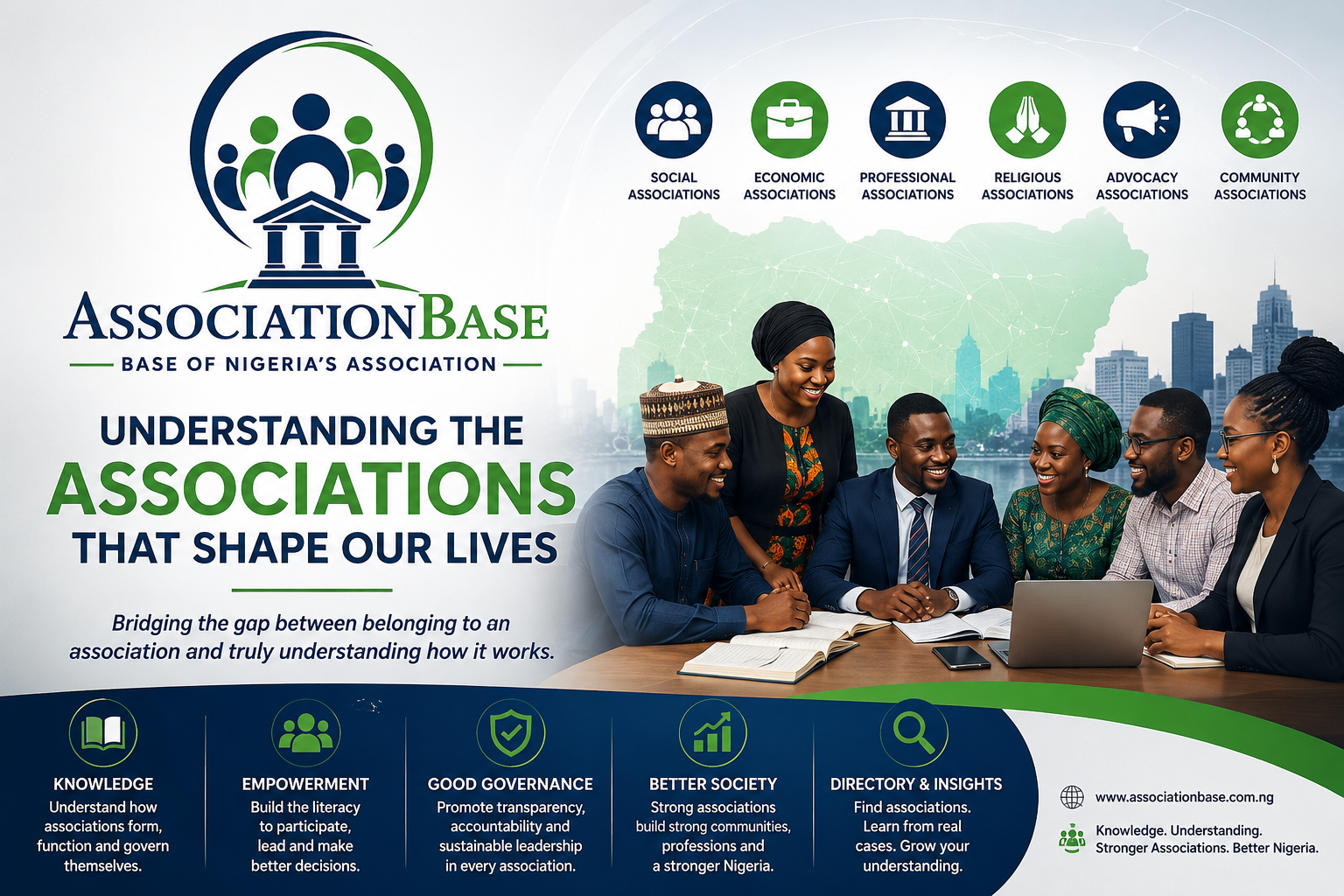
Bridging the gap between belonging to an association and truly understanding how it works.
Almost every Nigerian belongs to an association. But how many of us truly understand the organizations we belong to?
We join student unions before we can vote. We inherit membership in age grades, town unions, and religious congregations before we understand what membership means. We build professional bodies, cooperatives, and trade associations to protect our interests, yet most of us never read their constitutions. We follow leaders we did not fully vet, through decision-making processes we do not fully grasp, inside structures we assume — rather than know — are working in our favour.
AssociationBase exists to close that gap. It is a structured directory and knowledge platform built to help people understand how associations form, function, govern themselves, and shape the societies around them.
We Are All Part of Associations — But How Well Do We Understand Them?
Think about how many organized groups touch your life in a single week. A student association. A professional body. A trade union. A cooperative society. A religious congregation. A community development association. An alumni network. A social club. A digital community on WhatsApp or Telegram. Perhaps a political organization or caucus.
Associations are not occasional features of Nigerian life — they are constant ones. From the age-grade systems in Southern Nigeria to the trade guilds of Northern markets, from professional bodies like NBA and NMA to cooperative thrift societies in every community, organized group life is woven into how Nigerians work, worship, trade, govern, and belong.
And yet, a paradox sits at the centre of this reality: people participate in associations every day, but very few are ever taught how associations actually work.
Ask a typical member of an association a few basic questions, and the gaps appear quickly:
- Do you know what your association’s constitution actually says?
- Do you understand how your leaders are elected, and how they can be removed?
- Do you know how financial decisions are made, and who is accountable for them?
- Do you understand what happens when there is a serious internal conflict?
- Do you know what makes some associations last for generations while others collapse within a few years?
For most people, the honest answer is no. We treat membership as something we simply have, rather than something we understand. That is not a personal failing — it reflects a broader gap in how associational knowledge is taught and shared. AssociationBase was built to help close that gap, one structured piece of knowledge at a time.
What Is AssociationBase?
AssociationBase is a knowledge platform and structured directory dedicated to explaining how associations and organized groups form, function, govern themselves, and influence society.
More specifically, AssociationBase is:
- A structured knowledge base for understanding organized groups
- A research and educational resource on association formation and governance
- A directory that helps people locate and understand relevant associations
- A Nigeria-aware platform that grounds its content in local realities, structures, and case studies
It is important to be equally clear about what AssociationBase is not. AssociationBase is not merely a conventional blog publishing opinions about associations. It is not a political lobbying platform, and it does not exist to promote every association indiscriminately or to take sides in internal disputes. It is also more than a simple directory — it pairs its listings with structured explanation, so that finding an association and understanding it happen in the same place.
You can read more about this positioning on our About Us page, which sets out the platform’s founding philosophy in more detail.
Why AssociationBase Exists: The Missing Knowledge of Organized Groups
Every association is made up of three broad groups of people, and each group tends to be missing something important.
Members often don’t fully understand their association’s constitution, their rights and responsibilities within it, how decisions affecting them are actually made, or how leadership is held accountable when things go wrong.
Leaders often step into positions of authority without a clear grasp of governance structures, institutional accountability, succession planning, or how to resolve conflict in a way that strengthens rather than fractures the organization.
Founders — the people building new associations from scratch — frequently struggle with the basics of structure: how to define membership fairly, how to design governance that will still work in ten years, and how to build something sustainable rather than something dependent on one strong personality.
At the centre of all three gaps sits a single idea: understanding associations is a form of civic literacy. Just as financial literacy helps people manage money responsibly, associational literacy helps people participate in, lead, and build organized groups responsibly. It is knowledge that affects how communities function, how professions self-regulate, how religious and cultural life is organized, and ultimately how a society governs itself below the level of the state. AssociationBase treats this as knowledge worth taking seriously — and worth making accessible.
What AssociationBase Covers: The World of Organized Groups
Associations are not a single kind of thing. They take dramatically different forms depending on their purpose, structure, and the interests that bring people together. AssociationBase documents and explains this full landscape, including:
- Social associations
- Economic associations
- Political associations
- Religious associations
- Professional associations
- Secret and exclusive associations
- Coercive or force-based associations
- Advocacy-based associations
- Governance-based associations
Within these broad classes, AssociationBase explores dozens of distinct types of organized groups — from student unions and trade guilds to cooperative societies, alumni bodies, and professional regulatory associations — examining what each one is, how it forms, how it is structured, how it governs itself, how power operates within it, why some succeed while others fail, and how each one affects the wider society around it.
This breadth is deliberate. A platform that only covered one type of association — say, professional bodies — would miss the reality that most Nigerians move between several very different kinds of organized groups over the course of their lives, often in the same week.
The Four Pillars of AssociationBase Knowledge
To keep this broad subject organized and useful, AssociationBase structures its content around four core pillars.
1. Foundation
This pillar covers the basics: definitions, core concepts, classifications of associations, historical context, and the fundamental building blocks that every organized group is made of, regardless of its size or purpose.
2. Governance and Dynamics
This pillar goes into how associations actually operate day to day — leadership structures, decision-making processes, financial management, accountability mechanisms, conflict resolution, the distribution of power among members and officers, and how leadership transitions are handled when the time comes.
3. Case Studies
Here, AssociationBase examines real associations and organized groups to understand what worked, what failed, and why. Structure is easier to understand in the abstract; it becomes memorable when you can see it play out in a real organization’s rise or collapse.
4. Society and the Big Picture
The final pillar zooms out to explore the relationship between associations and the wider world — how organized groups connect to democracy, development, culture, community life, professional standards, and the future of how humans organize themselves collectively.
Together, these four pillars give AssociationBase a content architecture that moves logically from the basic building blocks of association life, through how organizations are actually run, into real-world examples, and finally out to the bigger societal picture.
Who Is AssociationBase For?
AssociationBase is built for anyone who belongs to, leads, studies, or is curious about organized groups — which, in practice, is nearly everyone. A few groups in particular will find direct value here:
Students, who belong to student unions, departmental associations, professional student bodies, and cultural organizations, and who often encounter association life for the first time without any guidance on how it works.
Researchers and academics studying sociology, political science, governance, organizational behaviour, or civil society, who need grounded, well-documented material on how associations actually function in practice.
Journalists and media professionals covering labour, governance, community affairs, or civil society, who need reliable background on the organized groups behind their stories.
Policymakers and public administrators who interact with associations as stakeholders, partners, or regulators, and who benefit from understanding how these groups are structured internally.
Association leaders and members who want to lead more effectively, understand their own organizations more clearly, improve accountability, and build institutions that outlast any single leader.
Founders and builders creating new associations, who need practical guidance on structure, membership design, governance, and long-term sustainability.
Curious citizens who simply want to understand the groups shaping their community, profession, social life, or country.
If you belong to an organized group — and almost everyone does — AssociationBase was built for you.
Our Philosophy: Understanding, Not Advocacy
This is the idea that most sharply defines AssociationBase: we document, explain, and analyse — we do not promote, condemn, campaign for, or take sides.
This neutrality is a deliberate choice, not a limitation. It means AssociationBase can examine successful associations and dysfunctional ones with the same level of rigour. It can look closely at controversial associations, failed associations, powerful associations, and ordinary community organizations, without an agenda pulling the analysis in one direction or another.
The goal is not to tell readers what to think about any particular association. The goal is to help them understand what they are actually looking at — so that they can form their own judgments with real information behind them.
This philosophy shapes how everything on the platform is written: clearly, in a structured and educational style, analytically rather than promotionally, and grounded firmly in Nigerian realities rather than abstract theory borrowed from elsewhere. You will find this same approach reflected in more detail on our About Us page.
How to Use AssociationBase — and Where We’re Headed
In practice, AssociationBase is a place you can come back to for different reasons at different times. You might use it to learn the basics of how associations form and govern themselves. You might use it to research a specific type of organization before joining or founding one. You might use it to study governance and leadership structures, explore real case studies of associations that succeeded or collapsed, or simply satisfy curiosity about a type of group you’ve encountered but never understood.
It is worth noting, too, that AssociationBase sits within the broader JummikPlus Global Services Resources Management Ecosystem — built on the idea that people possess resources beyond money, including knowledge, time, relationships, networks, skills, and affiliations. Associations are one of the most important environments in which these relationships and shared resources get organized, which is part of why understanding them matters as much as it does.
Looking ahead, our ambition is straightforward: to become a leading, comprehensive knowledge base for associations and organized groups — expanding our documentation, deepening our case-study coverage, and helping more people build the kind of associational literacy that strengthens how they participate in, lead, and build the groups that shape their lives.
Welcome to AssociationBase
Associations shape lives — quietly, constantly, and often without members ever stopping to notice how much influence these organized groups have over their professional opportunities, their communities, and their sense of belonging. Understanding those groups is not a niche interest; it is a practical form of literacy that benefits students, leaders, founders, researchers, and everyday members alike.
That is what AssociationBase exists to make accessible.
Explore the knowledge base. Read through our growing library of articles. Learn how associations are built, governed, and sustained. And if you lead, study, or are simply curious about an organized group, consider this an open invitation to start understanding it a little more deeply than before.