
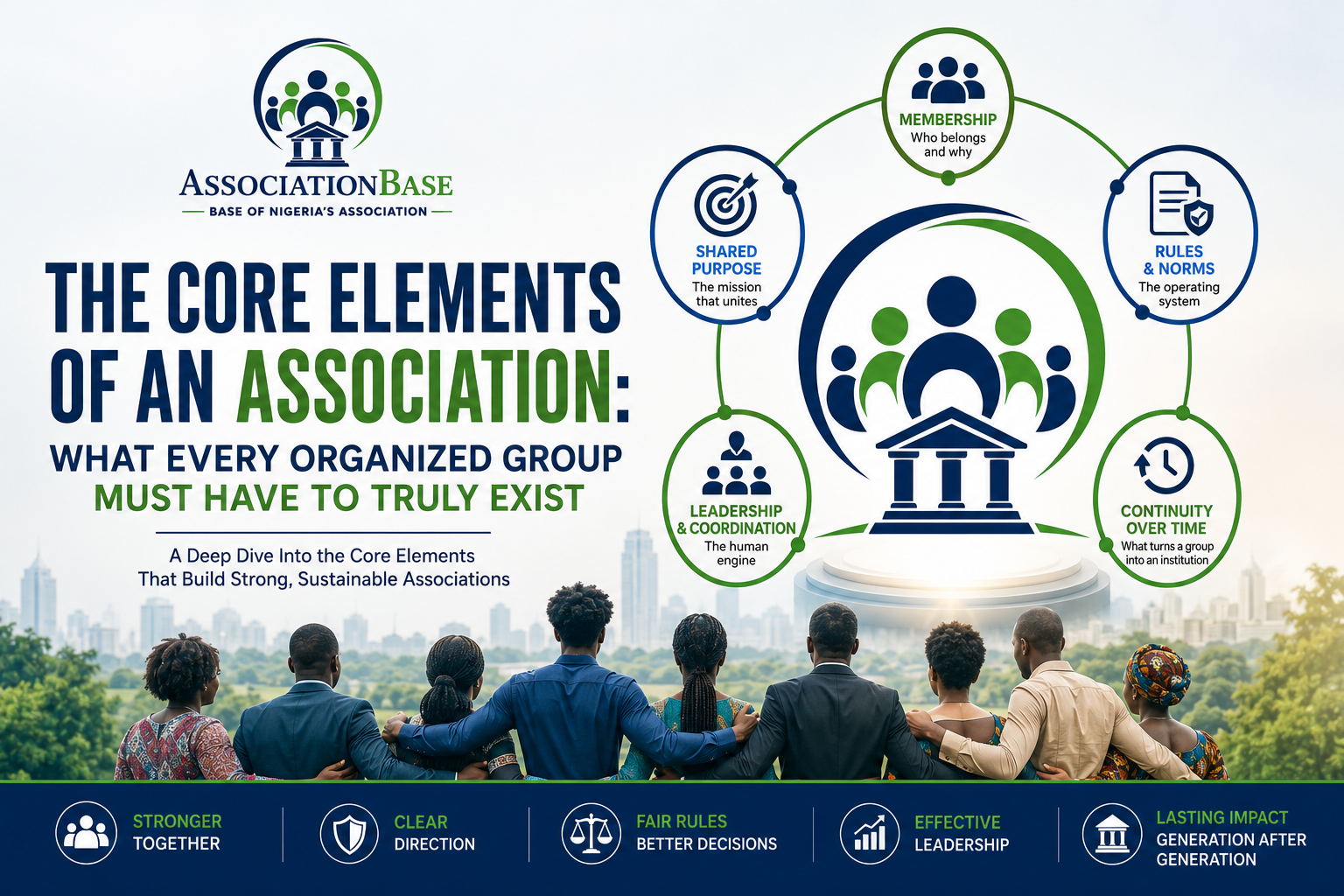
A Deep Dive Into the Core Elements of an Association
You belong to something. You always have.
Think about it for a moment. That departmental association you joined in your first year at university. The WhatsApp group your old secondary school classmates created and still argue in till today. The cooperative thrift group on your street where members pool money and take turns collecting. The church committee you were volunteered into before you could say no. The age-grade group in your hometown that somehow still knows your name even though you have not visited in three years.
Every Nigerian has a story like this. We are, by nature and by culture, associational people. We organize. We group. We gather. And yet, for all the associations we belong to, most of us have never truly understood what an association actually is — what it is built from, what holds it together, and why some groups thrive for decades while others collapse within months of being formed.
That gap in understanding is costly. It is why Nigerians join associations that later disappoint them. It is why members watch their professional bodies become political instruments. It is why founders build groups with genuine passion and watch them fall apart for reasons that could have been prevented. Most of these failures trace back to one root cause: the association was never properly built in the first place. One or more of its core elements was missing.
This article is designed to close that gap. At AssociationBase, our commitment is to give every Nigerian — student, professional, community member, or founder — the kind of association literacy that most people never receive. By the time you finish reading, you will have a clear, practical framework for understanding what makes a group an association rather than just a crowd or a temporary gathering. You will be able to evaluate any association you belong to, identify what is strong and what is weak, and make smarter decisions about the groups you join, lead, or build.
This is where your association literacy journey begins.
What Is an Association? The Definition You Need Before Everything Else
Before we talk about what makes an association work, we need to be precise about what an Association actually is. And that requires confronting a problem most Nigerians do not realize they have: we use the word “association” to mean almost everything.
Walk through any Nigerian market and you will hear it. Landlords Association. Traders Association. Okada Riders Association. Alumni Association. Students’ Association. The word is attached to so many different kinds of groups, in so many different contexts, that it risks meaning nothing in particular. That looseness is itself a problem, because it creates confusion about what these groups are, what they owe their members, and what their members owe them.
So let us start with a plain-language definition. An association is a group of people who come together around a shared purpose, operate under agreed rules, and sustain their relationship over time. That sentence deserves to be read slowly, because every word in it is doing work.
It is not just a group. It is a purposeful, rule-governed, time-sustained group. Consider the contrast. A crowd at a bus stop in Lagos shares a physical space, but there is no shared purpose, no agreed rules, and no intention to sustain the relationship. A WhatsApp group created to coordinate a wedding and abandoned two weeks after the ceremony has shared purpose temporarily but no real continuity. Neither of these is an association in any meaningful sense.
The German sociologist Max Weber drew a distinction that helps here. He separated what he called a communal relationship — where people act together based on feeling or tradition — from an associative relationship — where people act together based on rational agreement toward a shared goal. An association, in Weber’s sense, is a deliberate decision by people to organize themselves. It is not something they fell into. It is something they chose. And choices can be made well or poorly.
In Nigeria, the legal dimension adds another layer. An association that registers with the Corporate Affairs Commission (CAC) gains what lawyers call legal personality — the ability to own property, open a bank account, enter contracts, and sue or be sued. Legal registration is important. But it does not create an association. It only recognizes one that already exists through its structure. We have seen registered Nigerian associations that are completely non-functional, and unregistered community groups that exercise enormous real authority in their communities. What makes the difference is not the CAC certificate. It is the presence or absence of the core elements.
At AssociationBase, we define an association as any organized group that possesses five core attributes: membership, shared purpose, governing rules or norms, leadership or coordination, and continuity over time. When all five are present, you have an association — regardless of what the group calls itself. When any one is missing, the group is structurally incomplete. And that incompleteness will eventually show up as a problem. See this Article for a better understanding of what an Association is
What We Mean by Core Elements — Why These Five Are Non-Negotiable
There is an important distinction that every Nigerian beginner needs to understand before we examine each element. The distinction is between what an association has and what an association needs.
An association may have a logo, a uniform, a social media page, a physical secretariat, branded stationery, and a beautiful name. These are features an association can have. They are decorative — useful for visibility and identity, but not structural. A group can possess all of them and still be fundamentally broken.
The core elements are different. They are not about how the association looks. They are about what the association is. They are structural — meaning that the association’s ability to function, to serve its members, and to survive over time depends entirely on their presence.
Each core element passes what we call the “without this, it falls apart” test. Remove membership from an association and you no longer know who the group is or who it serves. Remove shared purpose and members have nothing to align around — the group dissolves into competing individual interests. Remove rules and there is no basis for decisions, no way to resolve conflict, no accountability for anyone. Remove leadership and there is no one to coordinate action; the group cannot move. Remove continuity and every new leadership cycle starts from zero; the group never becomes an institution.
This framework is particularly important for Nigerian beginners because many young Nigerians join associations based on social pressure, peer influence, or curiosity — without ever asking whether the association is structurally sound. Many founders launch groups with enormous energy and no blueprint, then watch them collapse for entirely preventable reasons. The five core elements give you the diagnostic tool to see what is really there, before you commit your time, your reputation, or your resources.
Element One — Membership: Who Belongs and On What Basis
Membership is the boundary mechanism of an association. It defines who is inside and who is outside. It is the answer to the most basic question any organized group must be able to answer: who are we?
Without clear membership, an association has no defined constituency. It cannot speak for anyone with authority, represent anyone with legitimacy, or serve anyone with precision. Membership is both practical and symbolic. Practically, it determines who participates, who contributes, and who benefits. Symbolically, it defines the group’s identity and gives its members something to belong to.
Membership criteria in Nigerian associations take many different forms. Professional associations like the Nigerian Medical Association require that members hold a specific qualification — in this case, a medical license. The Nigerian Bar Association requires that members have been called to the bar. Geographic associations like community development unions or hometown associations require that members originate from or reside in a specific location. Age-grade associations in Igbo and Yoruba communities determine membership by birth cohort — you belong to a specific grade because of when you were born, not because you applied. The Muslim Students Society and the Catholic Students Association of Nigeria use ideological and faith-based criteria. The Nigeria Union of Teachers uses vocational criteria — you must be a practicing teacher.
Some associations use open membership models, welcoming anyone who meets broad basic criteria — a willingness to join and pay dues. Others use closed membership models that restrict entry based on specific, non-transferable conditions. Neither model is inherently better. The right model depends entirely on the association’s purpose.
What happens when membership is poorly defined? The consequences are serious and familiar to any Nigerian who has spent time in organized groups. Ghost members appear on the register — people counted in the official numbers who have no real engagement, inflating size while hollowing out participation. Impostor members exploit the association’s resources or reputation without meeting the legitimate criteria. The group loses its sense of who it is. And sooner or later, a dispute erupts over who “really” belongs — a dispute that is almost always rooted in the failure to define membership clearly from the beginning.
If you are evaluating an association, ask who belongs and why. Is there a membership register? What are the criteria? If you are building one, invest serious time in defining membership before you do anything else. It is your first and most foundational decision.
Element Two — Shared Purpose: The Mission That Gives the Group Meaning
Membership brings people in. Purpose gives them a reason to stay.
Without shared purpose, an association is just a list of names. With it, those names become a force. Shared purpose is the soul of an association — it is the answer to the most important question any group must be able to answer: why do we exist?
Nigerian associations carry some of the clearest examples of this principle. The Academic Staff Union of Universities exists because Nigerian academics share a common purpose: protecting university autonomy, adequate funding, and staff welfare. ASUU’s strikes are controversial, but no one disputes that the organization has a clear sense of why it exists. The Nigerian Union of Teachers exists because teachers share the purpose of professional welfare, educational standards, and civic recognition. A market cooperative in Onitsha exists because traders share the purpose of collective savings, bulk purchasing, and security. A Christian Students Association chapter exists because students share the purpose of spiritual growth and faith-based community.
In each of these cases, purpose is not a slogan. It is the organizing logic that determines everything else — who should belong, what rules are needed, what leaders are supposed to do, and what the association should look like in ten years.
But here is a reality that AssociationBase thinks every Nigerian beginner needs to understand: there is often a gap between stated purpose and actual purpose. Many associations have beautifully written mission statements in their constitutions and operate for entirely different reasons in practice. A community development association whose constitution declares a mission of infrastructure development but whose actual function is to provide its chairman with political leverage is an association with a purpose gap. Spotting that gap — by comparing what the constitution says against what the association actually does, spends, and prioritises — is one of the most important skills any association member can develop.
There is also the problem of purpose drift. Purpose drift is the gradual shift of an association’s activities away from its original mission. It happens when new leadership brings different priorities, when external funding redirects the group’s focus, or when the original problem the association was built to solve has changed. A student association founded to advocate for student welfare that gradually becomes a vehicle for political campaigns has experienced purpose drift. It is not always intentional. But it is always dangerous, because an association that has lost its original purpose has lost its reason for being.
A sharp purpose produces a sharp association. A vague one produces a vague one.
Element Three — Rules and Norms: The Operating System of the Association
If membership defines who belongs and purpose defines why the group exists, rules define how the group operates. Rules are to an association what an operating system is to a phone — mostly invisible in daily life, but everything depends on them.
Without rules, every decision becomes a negotiation from scratch. Every conflict becomes existential. Every transition becomes a crisis. Rules answer the fundamental governance questions that every association must be able to answer: Who has authority? How are decisions made? What happens when someone breaks the agreement? How is money managed? How do leaders exit?
The most important written rule in any association is its constitution. A constitution is the supreme document of the association — the foundational agreement that defines what it is and how it operates. A functional Nigerian association constitution must address certain core areas. These include the association’s name and registered address, its mission and objectives, membership criteria and categories, leadership structure and titles, tenure and term limits, election procedures, financial management rules, meeting requirements, amendment procedures, and dissolution provisions.
Many Nigerian associations have constitutions that are dangerously incomplete. They define offices but not powers. They specify that elections must be held but say nothing about what happens when election results are disputed. They mention that finances must be reported but include no auditing requirements. An incomplete constitution is better than none — but not by much. The gaps become the battlegrounds.
Beyond written rules, every association also operates by unwritten norms — the informal expectations that members absorb over time. How meetings are opened. How elders are addressed. How disagreement is expressed. What topics are considered off-limits. In many traditional Nigerian associations — age-grade groups, market cooperatives, cultural societies — unwritten norms carry as much authority as any written rule. The risk, however, is that unwritten norms can be selectively invoked by powerful members to protect their interests, because there is no written record to challenge.
The most dangerous scenario in Nigerian associations is not the absence of a constitution. It is the presence of a constitution that no one has read, no one applies, and everyone ignores until a crisis erupts — at which point every faction interprets the document in its own favour. A constitution that lives in a drawer is not a functioning operating system. It is a decorative document. Enforcement requires members who know what the rules say, leaders who are accountable to those rules, and mechanisms — Annual General Meetings, audit committees, electoral processes — that activate the rules on a regular basis.
Element Four — Leadership and Coordination: The Human Engine
People with shared purpose and agreed rules still cannot act collectively without coordination. Leadership is the human engine of an association. It is what converts membership and mission into actual decisions, actual activities, and actual results.
This does not mean associations need authoritarian figures at the top. It means they need a coordinating authority — whether a single officer or a committee — with defined powers, clear accountability, and a genuine commitment to the association’s mission rather than their own advancement.
Nigerian associations organize their leadership in different ways. Most formal associations use the familiar executive committee model: president, vice president, general secretary, financial secretary, treasurer, public relations officer. Foundations and registered NGOs often use boards of directors or trustees. Traditional and cultural associations frequently rely on councils of elders, where authority rests with senior members by tenure or age. Smaller cooperatives and community groups sometimes use rotating chairpersons, where no single person holds permanent authority.
Each of these models has strengths and risks. The executive committee model is familiar and functional but can concentrate too much power in one person if checks and balances are weak. The elders’ council model carries cultural legitimacy but can be opaque and resistant to reform. The rotating chairperson model distributes power but can create coordination gaps when transitions are not managed properly.
Two specific leadership pathologies appear in Nigerian associations with troubling frequency. The first is the one-man association — where all real authority accumulates in a single individual. This person knows every password, controls every account, makes every decision, and attends every meeting on behalf of the body. The association runs smoothly — as long as that person is present, healthy, and honest. When they leave, everything leaves with them. Many Nigerian civil society organizations, community associations, and even professional chapter branches have collapsed this way.
The second pathology is the leaderless association — where leadership positions exist on paper but no one exercises real coordination. Everyone holds a title. Nobody takes responsibility. Activities are proposed at meeting after meeting and never executed. The association becomes invisible and ineffective, and members eventually stop seeing any point in participating.
Real leadership accountability looks like this: financial reports presented at general meetings, elections held at constitutionally specified intervals with results honoured, Annual General Meetings where leaders answer to the membership, audit committees with real power to review accounts, and recall procedures that members can actually invoke when things go wrong.
Element Five — Continuity Over Time: What Makes an Association a Structure, Not a Moment
Of the five core elements, continuity is perhaps the most underappreciated — especially by founders and new leaders. It is the element that separates a gathering from an institution, a moment from a structure, a good group of people from an enduring organization.
Continuity means the association is designed to outlast the people who currently occupy its positions. It means that when the current president finishes their tenure, the association does not reset to zero. It means that the institutional knowledge, the external relationships, the strategic commitments, and the organizational history of the association survive the departure of any individual member — including the founder.
What does institutional continuity actually require? It requires documented history — meeting minutes, financial records, correspondence, and decisions written down and properly preserved, not stored in someone’s personal phone or remembered only in the heads of current leaders. It requires knowledge transfer — when leaders exit, they hand over not just keys and account details but context: the history of key relationships, the background of ongoing commitments, the lessons learned from past failures. It requires succession planning — identifying and preparing the next generation of leaders before the current ones step down, not scrambling for replacements the week before an election. And it requires active member renewal — because an association that does not bring in new members is slowly dying, even if it does not know it yet.
The succession crisis is one of the most common and destructive institutional failures in Nigerian organized life. When a founding chairman departs, when a long-serving secretary-general retires, when an entire executive committee exits at once — the association faces its greatest structural test. If succession is not planned, if records are not kept, if the institutional relationships exist only inside personal contacts on one person’s phone, the association loses years of progress in a single transition.
We see this pattern repeatedly in Nigerian alumni associations that “relaunch” with a new website, a new WhatsApp group, and a press release announcing “a new era” — every single time a new executive takes over. The relaunch is necessary not because the previous team was incompetent, but because nothing was documented. The new team is genuinely starting from scratch because there is genuinely nothing to inherit.
Continuity does not mean an association never changes. A healthy association updates its constitution when needed, adapts its programmes when circumstances evolve, and refreshes its leadership models as it grows — while maintaining its core identity and mission. The enemy of continuity is not change. It is undocumented, unconstitutional, personality-driven change that leaves no institutional record and no structural inheritance.
How the Five Elements Work Together — Why You Cannot Have One Without the Others
The five core elements are not a checklist. They are a system. Each element depends on the others, and the weakness of any one element undermines the entire structure.
Consider what happens when elements are missing in combination. Membership without shared purpose produces a listless crowd — people who belong to something but have no idea why, or what they are collectively working toward. Shared purpose without rules produces an enthusiastic but ungovernable group — people who agree on the mission but cannot agree on how to pursue it, so the most assertive personality always wins. Rules without leadership produce a constitution that no one enforces — a document that exists but has no power, because there is no one accountable for applying it. Leadership without continuity produces a rotating cycle of rise and decline — capable leaders who build momentum that vanishes the moment they exit. And continuity without membership produces an institutional shell — records, history, and a bank account, but no living people to carry the organization forward.
This is the system insight that transforms your understanding. Each element needs the others to be meaningful. Membership needs purpose to be motivated. Purpose needs rules to be pursued with consistency. Rules need leadership to be enforced. Leadership needs continuity to accumulate institutional impact. Continuity needs membership to have anyone to continue for. Remove any single element and the whole system weakens. Remove two and collapse becomes a matter of time.
What Happens When an Element Is Missing — Real Consequences for Real Nigerian Associations
Understanding the five elements in theory is valuable. Understanding what their absence looks like in practice is essential. Most Nigerian association failures are not mysteries. They are predictable outcomes of specific missing elements.
When membership clarity is missing, the association suffers an identity crisis. No one can tell you with precision who the real members are. Different people quote different membership numbers. Elections are contested on the grounds of who is “genuinely” a member. The association cannot speak for anyone with authority because it does not know with confidence who it represents. Nigerian professional chapter branches have split into parallel factions — each with its own executives, its own bank account, and its own membership register — entirely because founding membership criteria were never clearly defined.
When shared purpose is missing, the association becomes directionless. Meetings are held with no decisions. Different leaders pursue different agendas with no connecting logic. Members stop attending because participation produces no visible outcome. Dues collection collapses because no one can articulate what the dues are funding. A neighbourhood residents’ association that started to address security and drainage issues and gradually became a vehicle for collecting monthly levies whose application no one can explain — that is a purposeless association in slow decline.
When rules are missing, the association becomes lawless. Leadership tenure becomes indefinite. Finances become personal. Conflict becomes existential because there is no constitutional mechanism for resolution. Whoever holds power defines the rules in real time — which means the rules always favour whoever holds power. A market traders’ association run by a chairman who has served eleven years with no election, whose personal bank account functions as the association’s treasury — that is the consequence of absent rules.
When leadership is missing, the association becomes paralysed. Activities are proposed and never executed. External parties cannot identify a reliable contact. Members disengage because the association never delivers anything. When a university departmental association’s elected executives are too consumed with personal pressures to coordinate a single event, and no accountability mechanism exists to address it, the association exists in name only.
When continuity is missing, the association perpetually restarts. Each new executive discovers everything for the first time. The same mistakes are made repeatedly because no one documented the lessons of the previous cycle. Relationships built by previous leadership must be rebuilt from scratch. The association grows for two years and resets — grows and resets — never accumulating the institutional capital that would allow it to become something lasting.
Frequently Asked Questions
What is the simplest way to explain what an association is to someone who has never heard the word used precisely?
An association is a group of people who have deliberately decided to organize around a shared goal, operate by agreed rules, and sustain their relationship over time. The key word is “deliberately.” An association is not something people fall into. It is something they consciously choose to build and maintain together. A crowd, a WhatsApp group, or a one-time gathering does not qualify. An organized group with defined membership, a clear mission, governing rules, accountable leadership, and the intention to continue over time — that qualifies.
Do all Nigerian associations need to be registered with the CAC to be legitimate?
No. Legal registration with the Corporate Affairs Commission grants an association formal legal personality — the ability to own property, open accounts, and enter contracts. But many powerful and functional Nigerian associations operate without formal CAC registration. Community age-grade groups, market cooperatives, and cultural associations frequently operate informally yet command enormous social authority. Registration is important for associations that need to transact formally or hold significant assets. But legitimacy in the eyes of members comes from the presence of the five core elements — not from a certificate.
Can an association function with only some of the five core elements in place?
An association can exist in a limited or fragile form with some elements missing. But it will not function well, and it will not last. The elements are interdependent — each one reinforces the others. An association with strong membership and clear purpose but no rules will eventually be torn apart by a governance crisis. An association with rules and leadership but no continuity will reset with every election cycle. The goal is not to have some elements — it is to have all five, and to keep strengthening each of them over time.
What is the single most important thing a Nigerian founder can do before launching a new association?
Draft a thorough constitution before recruiting your first member. The constitution is the foundational document of the association — it defines membership, mission, leadership structure, tenure, decision-making processes, financial management, and dissolution. Associations that skip this step always pay for it later, usually in the form of leadership disputes and financial opacity. Engage a lawyer or an experienced association builder if you can. Invest the time to make the document thorough, clear, and enforceable. It is the most important thing your association will ever produce.
How can a Nigerian association member tell whether the association they belong to is structurally healthy?
Start with five questions. First, is there a membership register and are the criteria clear? Second, does the association have a stated purpose that matches what it actually does? Third, is there a constitution — and is it actually applied? Fourth, are elections held regularly, is financial reporting done at general meetings, and are leaders genuinely accountable? Fifth, does the association have institutional records that survive leadership transitions? If the answers to most of these questions are yes, the association has a reasonable structural foundation. If the answers are mostly no, the association is at structural risk — regardless of how active its social media page is.
Conclusion — Your Association Literacy Starts Here
You came into this article as someone who belongs to associations. We hope you are leaving it as someone who understands them.
That shift — from participant to informed participant — is precisely what AssociationBase was built to create. Because when you understand the structure beneath the group, you become a different kind of member. You ask better questions. You recognize warning signs early. You make deliberate decisions rather than reactive ones. You contribute more effectively. And if you ever choose to build something of your own, you build it on a foundation that can actually hold.
The five core elements — membership, shared purpose, rules and norms, leadership and coordination, and continuity over time — are not abstract theory. They are a practical framework that applies to every organized group you will ever encounter. The student union at your university. The professional body you joined after qualifying. The community association in your neighbourhood. The cooperative your colleagues formed at work. Each of these can be evaluated against these five elements. Each of them is stronger or weaker depending on how fully these elements are present and how well they are maintained.
At AssociationBase, this article is the beginning of a much deeper conversation. In the articles ahead, we will go further — into how to draft a constitution that actually works, how to design membership structures that serve the association’s mission, how to build leadership systems that prevent power abuse, and how continuity is built and protected across leadership generations. Every article is written in the same spirit: clear, patient, Nigeria-grounded, and built for readers who want to understand, not just participate.
Nigeria’s associations need more members who understand what they belong to. They need more leaders who serve the mission rather than the position. They need more founders who build structures that outlast them. Association literacy is not a luxury. It is a civic skill — and it begins with understanding what an association truly is.
You now have that understanding. Use it. Share it with your classmates, your colleagues, your community. And whenever a question about organized groups brings you back to AssociationBase, know that we will be here — documenting, explaining, and building the knowledge base that Nigerian association life deserves.
Explore AssociationBase. Understand the groups that shape your world.
Published by AssociationBase — Understanding How Organized Groups Work.
AssociationBase is a platform within the JummikPlus Global Services Resources Management Ecosystem.